

October's Identity Lesson: The Things We Trust to Act for Us
A backup app, an MFA app, an AI coding tool and an SSO directory. Four identity stories from October 2026, one pattern, and the three questions I'm taking to Fal.Con Europe
 Kev Johnson
9 min read

I'm heading to Fal.Con Europe in Barcelona this week. The theme is "Securing the AI Revolution", and the conversation on the show floor will be about AI agents: how to give them identities, how to scope what they can do, how to know what they did.
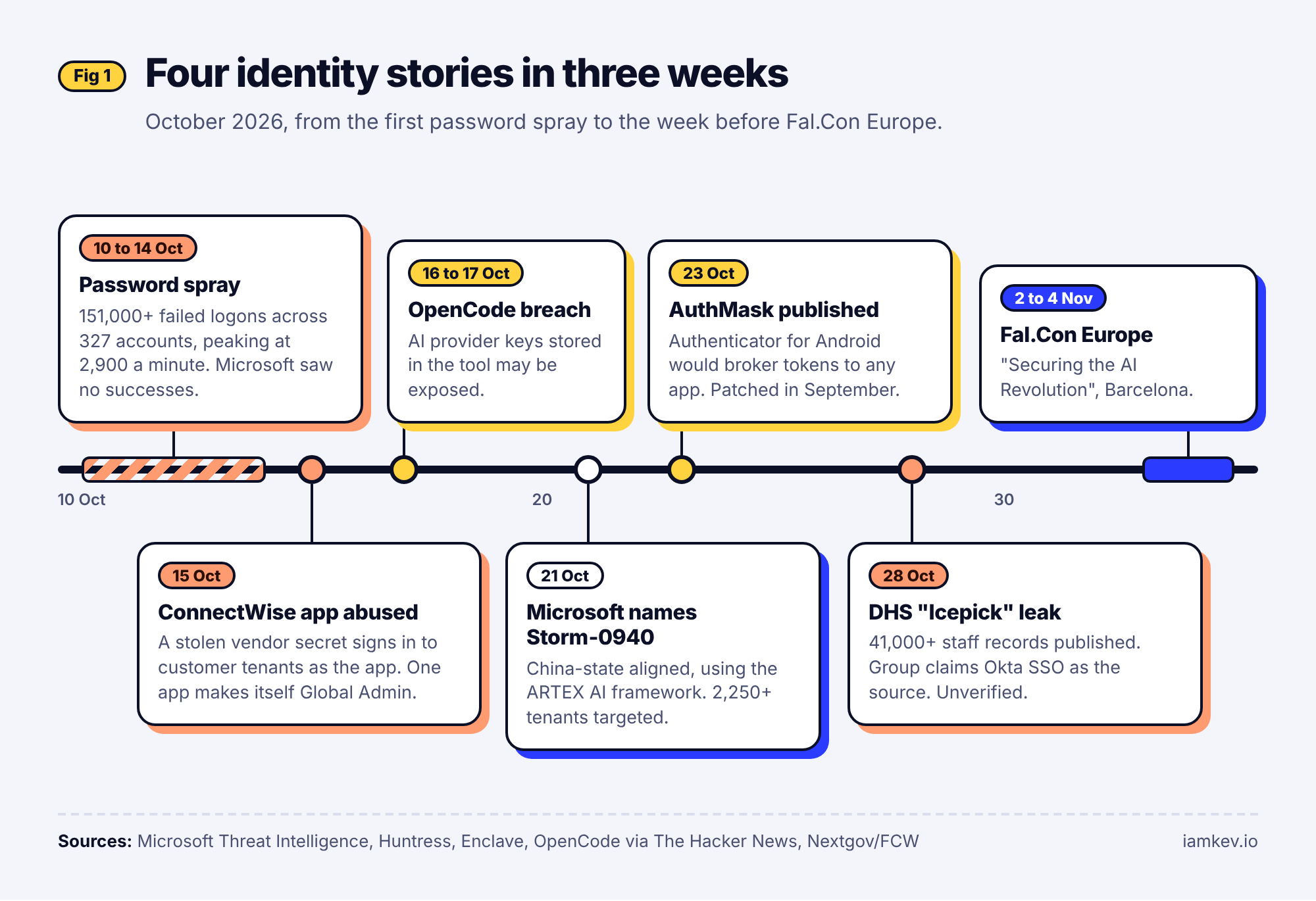
Before I go, I wanted to write down what October actually looked like from an identity point of view, because I think it is the best argument for that conversation we are going to get. Four stories landed in the space of three weeks. On the surface they have little in common. A Microsoft 365 backup app, the Microsoft Authenticator app on Android, an AI coding tool and a government department's single sign-on directory.
Look a little closer and they are the same story told four times. In every case, the thing that was abused was something we had trusted to act on our behalf. And in most of them, the controls we have spent a decade building around human sign-in did not get a vote.
One: the backup app that became a Global Admin
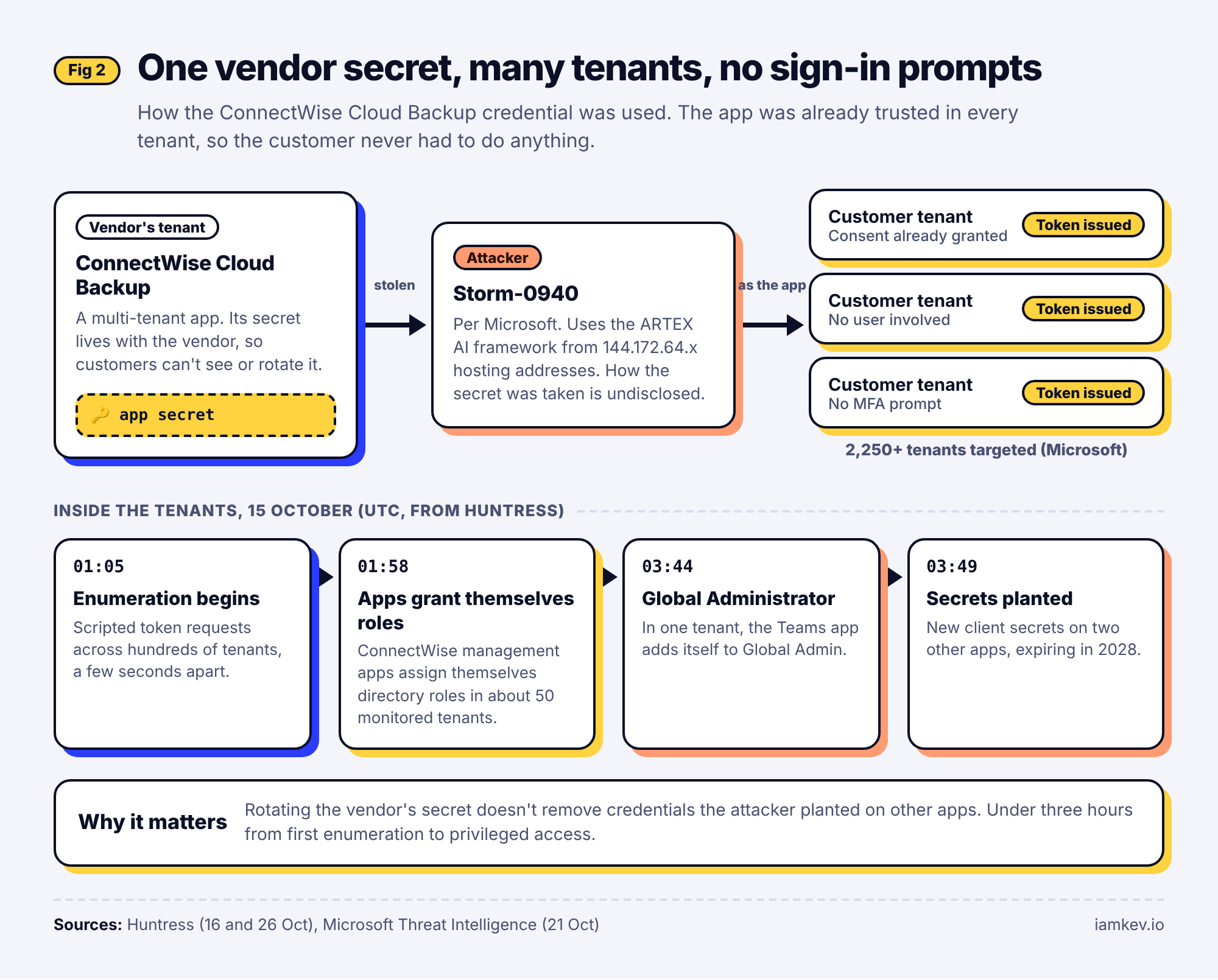
I have written about this one at length already, so the short version. On 15 October, someone holding the API secret for ConnectWise Cloud Backup (the Microsoft 365 backup product many people still know as SkyKick) used it to request Microsoft Graph tokens inside customer tenants. Because the app was multi-tenant and already consented everywhere it was installed, it needed nothing from the customer. No user signed in, so no MFA prompt ever appeared.
Huntress confirmed unauthorised sign-ins in 173 tenants they protect. In one, a ConnectWise Teams app added itself to Global Administrator and then planted new client secrets on two other apps in the tenant, set to expire in 2028. On 21 October Microsoft attributed the campaign to Storm-0940, which it describes as a China-state aligned actor, and said the group attempted sign-ins to more than 2,250 tenants using ARTEX, an open-source multi-agent AI penetration testing framework. Microsoft also describes the same actor running a password spray between 10 and 14 October that generated more than 151,000 failed logons, peaking at around 2,900 a minute, and in some post-compromise cases reading secrets in bulk from Azure Key Vault.
Huntress's follow-up is worth reading for one line in particular. They found the operator sloppy, adding and removing secrets, retrying failed uploads, spraying one tenant's secrets at tenants where they could never work. It worked anyway, because the stolen app credential did most of the heavy lifting. That is the point. Tooling makes attacks faster. Standing, over-privileged credentials are what make them succeed.
ConnectWise has been bringing the service back in phases through a replacement application, with customers having to re-authorise each tenant (TBBW). How the secret was stolen has still not been disclosed.
Two: the MFA app that would hand tokens to anyone who asked nicely
On 23 October, researchers at Enclave published the details of AuthMask, a flaw in Microsoft Authenticator for Android tracked as CVE-2026-80097 and rated 8.6 by Microsoft. It is a lovely piece of research, and I think it is the most under-appreciated story of the month.
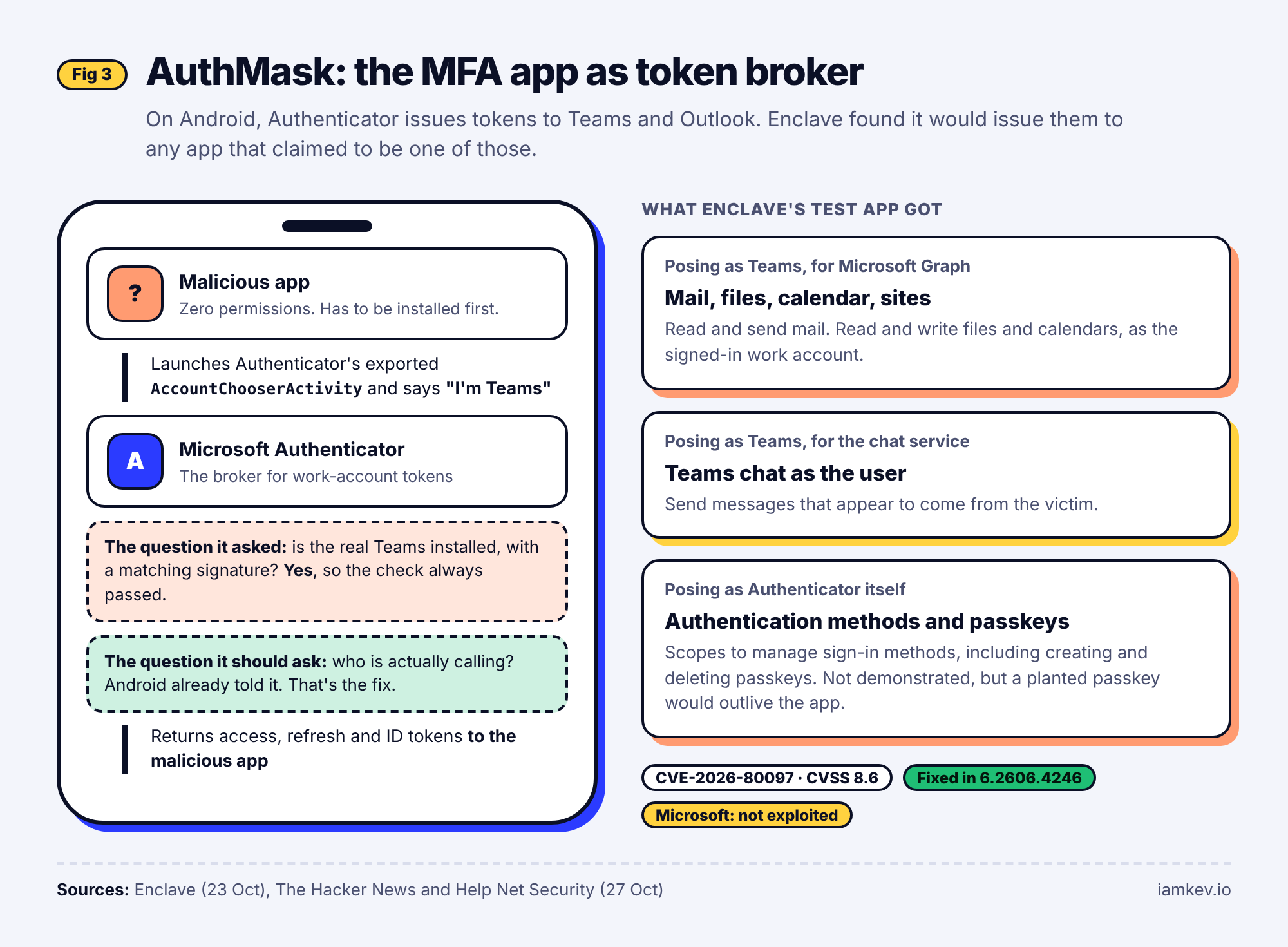
Most people think of Authenticator as the thing that pops up and asks you to approve a sign-in. On Android it is also a broker. When Teams or Outlook needs a token for your work account, they ask Authenticator, and Authenticator issues it. That makes it one of the most trusted pieces of software on the phone.
Enclave found that one of Authenticator's components could be launched by any app on the device, with no permissions at all. The calling app supplied the whole request, including which app it claimed to be. Authenticator checked that claim by comparing it with the signature of the real app, which was installed, so the check always passed. The irony is that Android told Authenticator who the real caller was. Authenticator just did not use that information to decide whether to issue the token.
In their testing, pretending to be Teams got Graph tokens that could read and send mail, read and write files and calendars, and send Teams messages as the user. Pretending to be Authenticator itself got tokens with scopes to manage the user's authentication methods, including creating and deleting passkeys. Enclave did not demonstrate actually adding a passkey, but Help Net Security points out the obvious risk: an attacker who registers their own passkey keeps access after the malicious app has gone.
The proportionate view matters here. Microsoft fixed this in Authenticator for Android 6.2606.4246, published the CVE on 8 September, says it was not exploited, and rates exploitation as less likely. Microsoft also says the user has to complete an authentication flow, which is reflected in its scoring, while Enclave says their proof of concept needed nothing beyond a signed-in account (The Hacker News). Either way, an attacker first has to get a malicious app onto the phone.
But the lesson is bigger than the bug. The MFA app is no longer just a second factor. It is a token broker, and the token broker is a target. If your mobile estate is unmanaged, you probably have no idea which Authenticator version your users are running.
Three: the AI tool holding everybody's keys
On 17 October, OpenCode, an open-source AI coding agent, emailed some of its users with the subject line "Action Required: Potential provider key breach". An intruder had reached what the company called a legacy system, and API keys that users had saved in OpenCode Console for OpenAI, Anthropic and Google may have been exposed. OpenCode said 1.4% of Console users were affected, and that keys stored only in its CLI or desktop apps were not, because those "never come to us" (The Hacker News).
Users reported unexpected charges, from a few hundred dollars to more than $1,700 overnight, and BleepingComputer reported that Google suspended some projects for activity consistent with hijacked resources. OpenCode linked the incident to a large-scale distillation attack, using stolen access to other people's models at scale, though it has not explained the connection or how the system was reached. Co-founder Dax Raad said attackers had been working at the company's systems for about 48 hours.
This is the smallest of the four stories by impact, and I think it is the most predictive. AI tooling is a new and very fast-growing place where long-lived credentials pile up. Every agent, coding assistant and automation needs keys to something, and the path of least resistance is to paste a key that never expires into a tool you installed last week. Those keys are identities. They just do not show up in anybody's identity governance.
One practical note from the coverage that applies well beyond OpenCode: deleting a key from the tool that held it does nothing. You have to revoke it with the provider that issued it.
Four: the directory itself
On 28 October, Distributed Denial of Secrets published a searchable dataset it called Icepick, with records on more than 41,000 current and former Department of Homeland Security employees and contractors: names, contact details, job titles and internal group memberships across ICE, CBP, CISA and other components (Nextgov/FCW, Help Net Security). The hacktivist group that supplied it says the data came from an Okta single sign-on service used by DHS.
I want to be careful with this one, because very little about the access path is established. DHS has said only that it is aware of a "potential breach". Okta says it has no evidence its own data or systems were compromised. Reporters at Reuters and Nextgov have verified some individual entries, so at least some of the data is real. Nobody has shown how it was obtained. A provider compromise, a stolen session in a customer tenant, an over-permissioned integration or a plain directory export would all look the same from the outside.
The reason it belongs in this post is not the how. It is the what. The most sensitive thing in that dataset is not the phone numbers. It is the group memberships. A directory does not just say who someone is. It says what they are allowed to do, which teams they sit in, and by implication what they work on. We tend to treat directory read access as harmless, the sort of thing every app and integration gets by default. Icepick is a sharp reminder that the directory is a map of the organisation, and maps are valuable.
The pattern
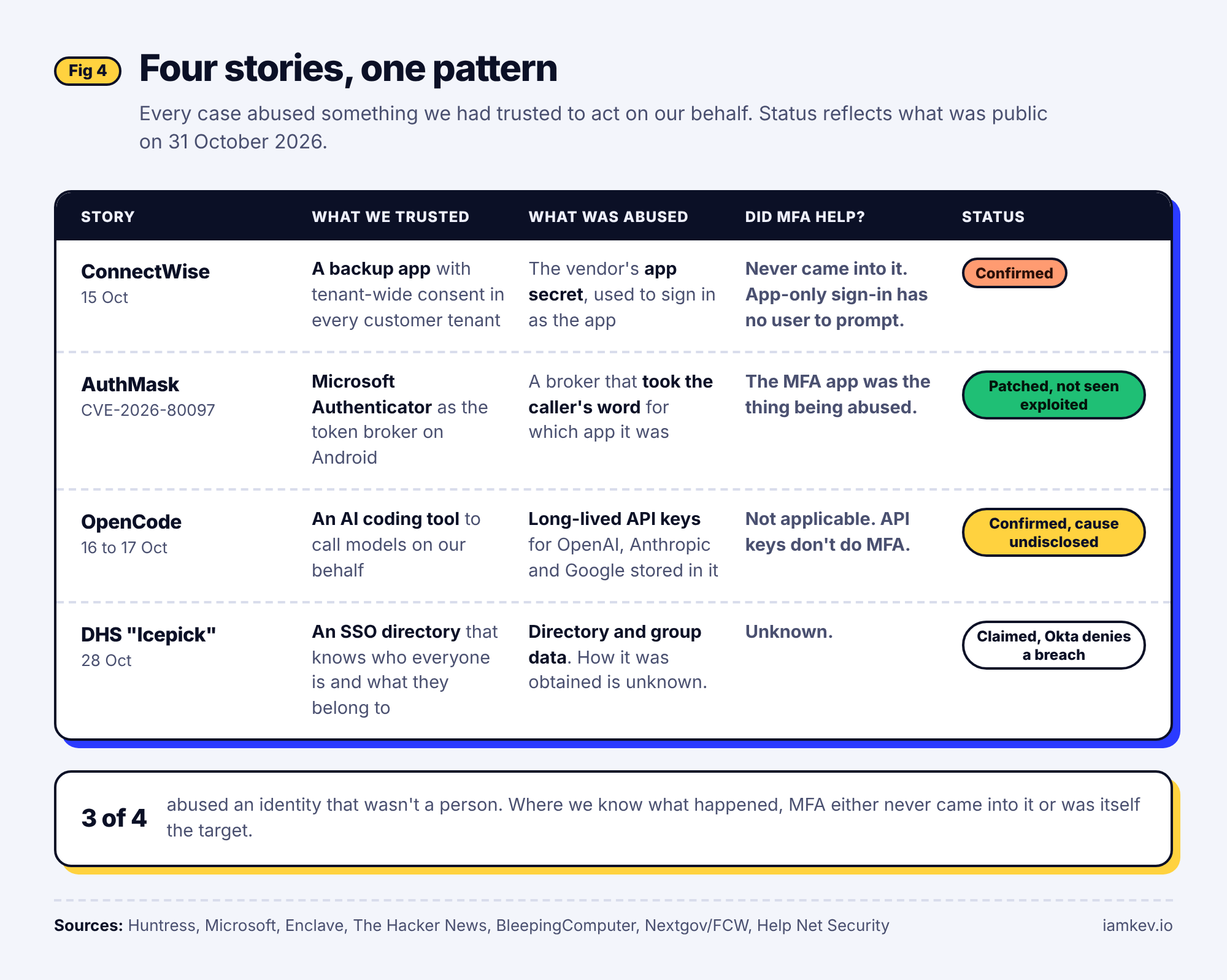
Put the four side by side and the pattern is hard to miss.
Four stories, one pattern: what was trusted, what was abused, and whether MFA helped
In each case we had delegated trust to something so that it could act for us. A backup app to read and restore our tenant. A broker app to hand out tokens to our other apps. An AI tool to call models on our behalf. An SSO service to know who everyone is and what they belong to. In three of the four, the identity that was abused was not a person. And where we know what happened, MFA either never came into it or was itself the thing being abused.
None of these are exotic. They are the ordinary plumbing of a modern estate. That is what makes them dangerous. We grant the access once, at onboarding, and then nobody looks at it again.
And this is the backdrop for Fal.Con. The industry is about to give AI agents identities and permissions at a scale that dwarfs the app registrations we already struggle to govern. CrowdStrike, for example, announced an Agentic Identity Provider in September built around registering agents, giving them verifiable identities and brokering short-lived, tightly scoped tokens rather than standing credentials. Whatever you think of any particular product, that design direction is the right response to October. A planted secret that expires in 2028 is the exact opposite of it.
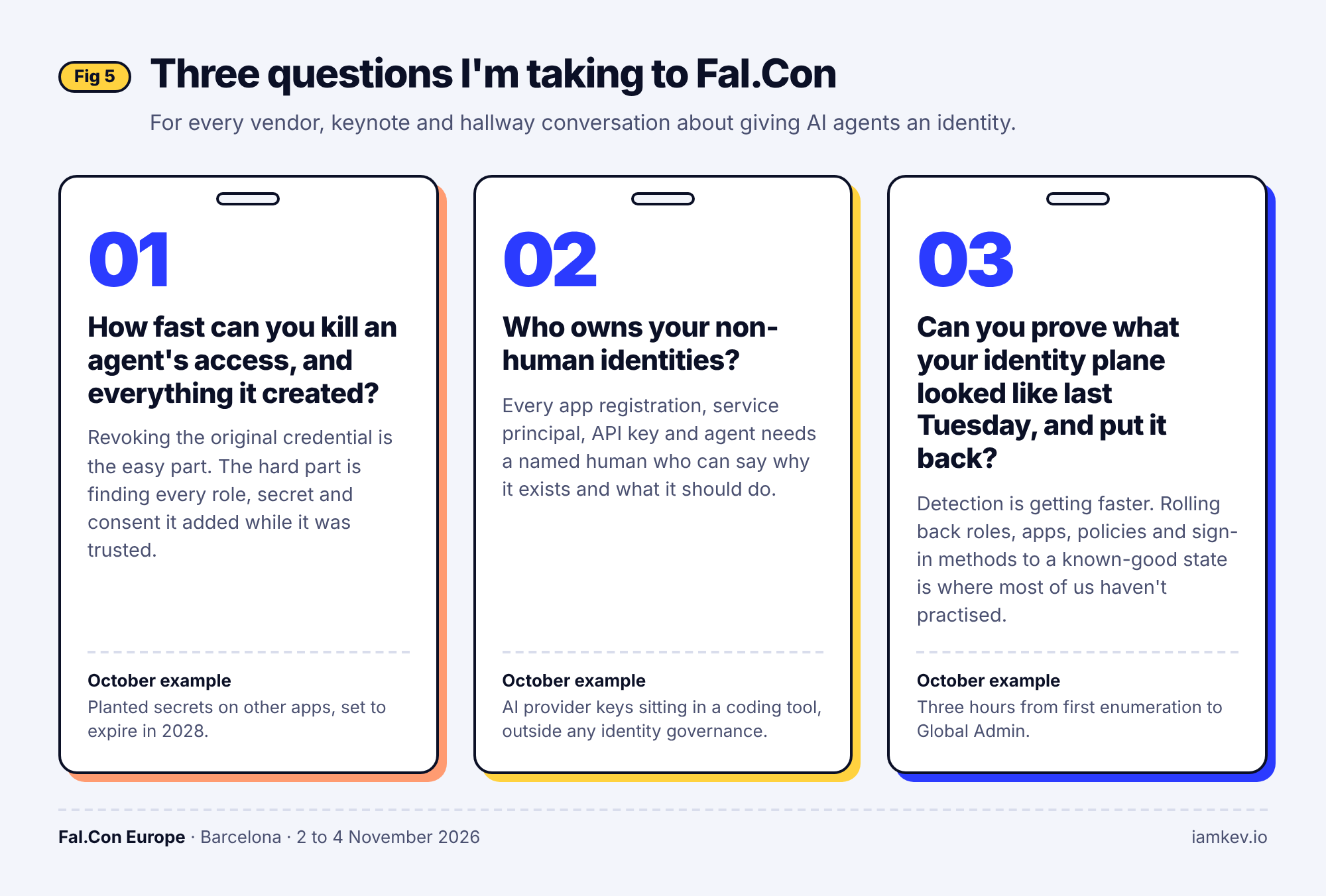
Three questions I'm taking to Barcelona
So here is what I will be listening for, in every keynote, every booth conversation and every hallway chat.
How fast can you kill an agent's access, and everything it created? Revoking the original credential is the easy part. ConnectWise rotated its secrets, and the attacker's planted ones on other apps would still have worked. Disabling an app stops new tokens, but issued tokens can live on for a while. Killing access properly means finding every credential, role assignment and consent the identity created while it was trusted, and that means you need the audit trail before the incident, not after it.
Who owns your non-human identities? Every app registration, service principal, API key and agent needs a named human who can say why it exists and what it should be able to do. Most organisations cannot produce that list. In my experience, the first time anyone tries, they find apps from tools that were trialled once and forgotten, still holding tenant-wide permissions.
Can you prove what your identity plane looked like last Tuesday, and put it back? This is the one I care about most, and the one I hear least about. Detection is getting better, and agents will make it faster again. But if a trusted identity spends three hours changing roles, apps, policies and authentication methods, the question after containment is what changed, and how you get back to a known-good state. Most teams can restore a deleted user. Far fewer can roll back a directory. I was reminded of exactly how hard that is in my own lab this month, when a rolled-back domain controller sat quietly for eighteen days before taking DNS down with it. You can find that post here.
What to do this week
If you want something concrete before the conference season washes over everything, here is where I would start.
Pull the list of enterprise applications in Entra ID that hold application permissions to Graph, Exchange or SharePoint, and put a name next to each one. Alert on any service principal that adds itself to a directory role or adds a credential to another app. Look at Entra's application management policies to block or cap client secrets. Make sure Microsoft Authenticator on your users' Android devices is at 6.2606.4246 or later, and if you cannot answer that question, that is a finding in itself. Find out where your developers are storing AI provider keys, give each tool its own key with a spend limit, and remember that revocation happens at the provider. And treat directory read access, especially group membership, as the sensitive data it is.
If you are at Fal.Con this week, come and find me. I would like to hear how you would answer those three questions, and which one is hardest where you work.