

The trust you forgot to revoke
A vendor's AWS credentials opened idle integration roles at customers, and Entra and Okta secrets were tested. What to check this week.
 Kev Johnson
6 min read

For about a fortnight in October, someone holding a vendor's AWS credentials walked through front doors that customers had built for that vendor and then forgotten about. Wiz says the activity ran between 14 and 26 October, and that most of the roles involved had nothing else to do that month. They sat there, unused, trusted and ready.
This is a post about idle trust, and what it can cost you. It also has an identity twist: the secrets the intruder went looking for included Microsoft Entra ID and Okta credentials.
What happened
Qubole is a big data and analytics platform. Its customers connect it to their AWS accounts with cross-account IAM roles, which means nobody has to hand over a long-lived access key. It is a sensible, standard pattern, and the pattern is what was abused.
On 9 November, Wiz published a report, written with Sentra and Mandiant, after Sentra spotted suspicious activity in some of its customers' environments. In short:
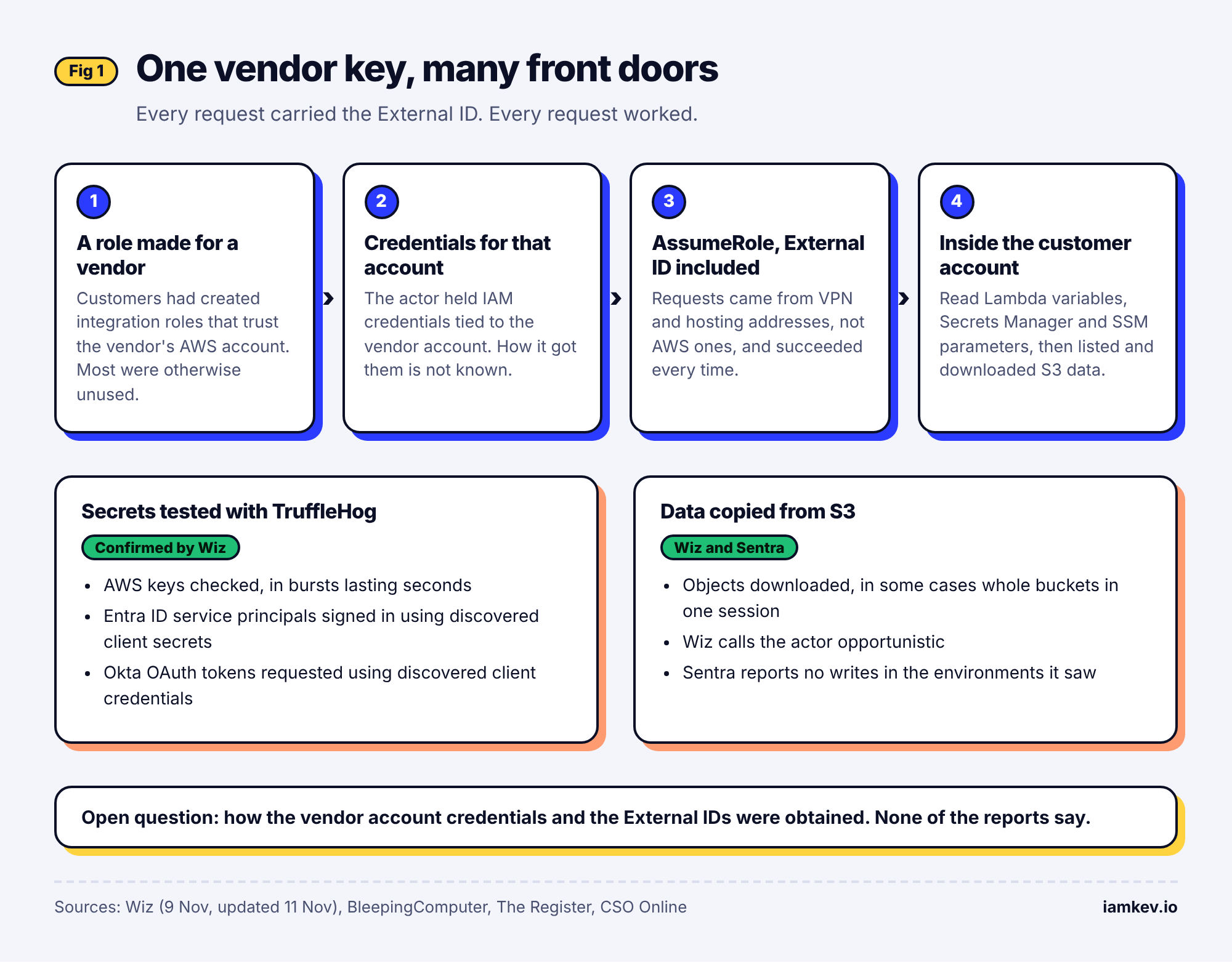
- An actor used IAM credentials tied to Qubole's AWS account to call
sts:AssumeRoleon roles that customers had created to trust that account. The first activity Wiz saw was on 14 October. A second IAM user from the same account appeared on 18 October. - Every request Wiz attributes to the actor carried the correct External ID, and every one succeeded. The requests came from VPN and hosting addresses rather than AWS ones.
- Inside each account, the actor listed resources, read Lambda environment variables, and pulled secrets from Secrets Manager and SSM Parameter Store.
- It then tested what it had found with TruffleHog. AWS keys were checked in bursts lasting seconds. Wiz also reports that Entra ID service principals signed in using discovered client secrets, and that Okta OAuth tokens were requested using discovered client credentials.
- The actor downloaded S3 data, in some cases whole buckets in one session. Wiz describes it as opportunistic rather than targeted.
On scale, Wiz gives no total. BleepingComputer reports the campaign affected tens of companies, and that Sentra confirmed dozens of victims and, in one case, millions of files stolen. Sentra also says the actor collected roughly 100 passwords and keys in seven minutes.
Why it worked
Three things lined up.
The door was open by design. An External ID is meant to stop one customer's trust being used against another. It is not a password. Wiz's advice is to treat External IDs as non-secret, because they appear in plaintext in CloudTrail. My read: that leaves the vendor's own credentials as the real lock, and you do not control those.
Nobody was using the roles. Wiz says most of the roles the actor assumed were otherwise unused, and in most affected environments these requests were the only AssumeRole calls from the vendor account in October. Sentra adds that some organisations had stopped using Qubole while the integrations stayed trusted. An idle integration role is a spare key left with a neighbour who has since moved house.
The trust was broad. Wiz recommends naming the vendor's specific principal rather than the whole account, and adding a source IP or VPC endpoint condition. It says a source IP condition alone would have blocked every assumption it observed.
AWS said, in statements carried by BleepingComputer and The Register, that its services were not compromised and "operated as designed", and recommended reviewing cross-account roles, removing unused integrations, applying least privilege and adding conditions such as source IP restrictions to trust policies. Both things can be true: the service did what it was configured to do, and the configuration was the exposure.
The identity angle
A secret that has been tested and works is a working credential. Wiz reports that Entra service principals signed in and Okta tokens were requested, so the AWS-side read became an identity-provider-side authentication.
What I could not find is any source saying the actor went further. Nothing I read reports Entra or Okta tenants being misused beyond that testing, and I would not claim it. My read is that this changes the question defenders should ask. Not "did they use it?" but "could they have, and what would it have reached?"
The Week 45 episode of Last Week in Identity covered exposed secrets being found and abused; this is the quieter version, where a vendor you chose to trust can read them out of your own account.
What's confirmed, reported and unknown
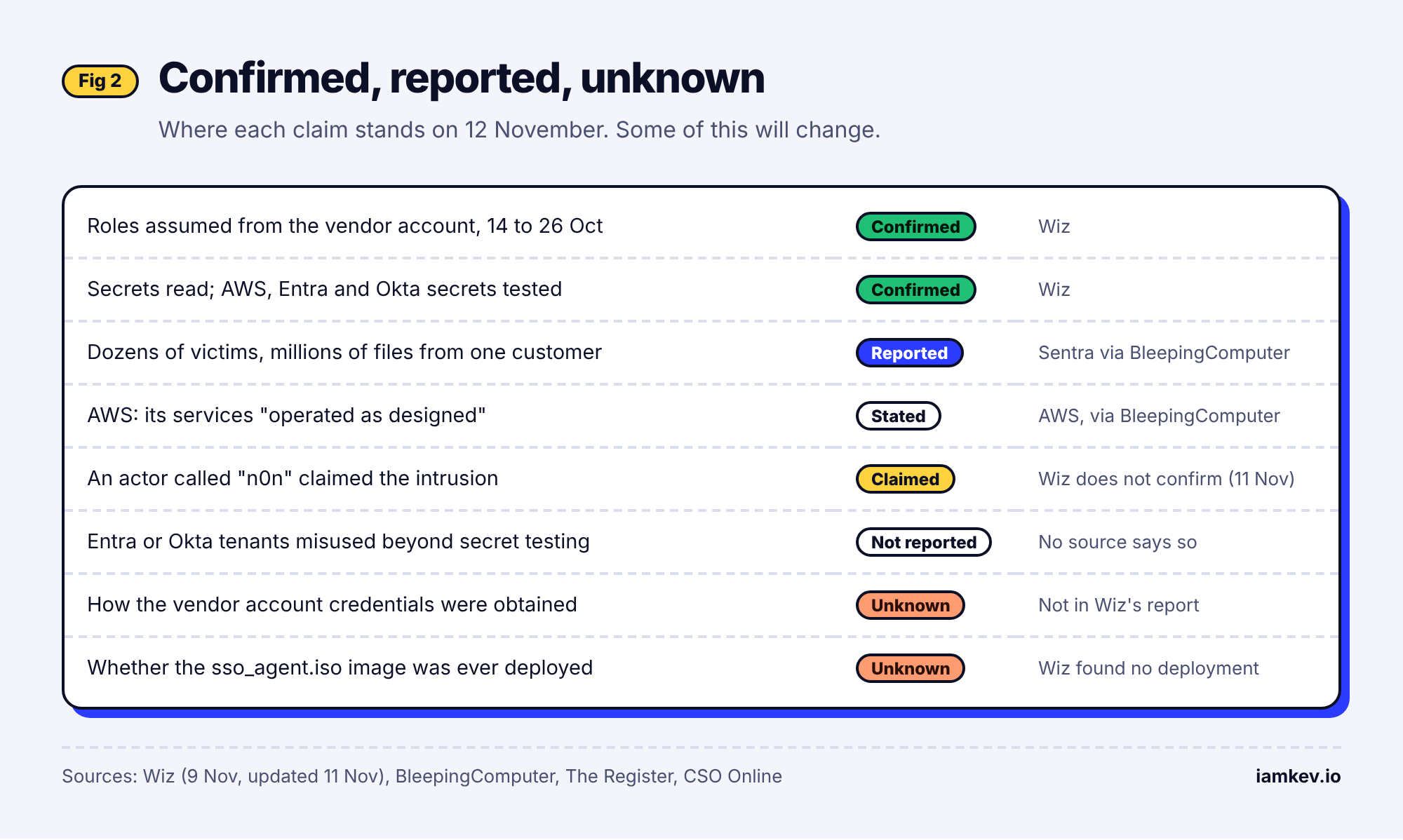
The honest answer is "some of each", and it will move.
Wiz has confirmed the role assumptions, the secret reads and the testing from its own observations. Sentra's victim numbers come via press reports. Nobody has said how the vendor-account credentials and External IDs were obtained. Wiz's 11 November update notes that Catalin Cimpanu of Risky Business reported an actor calling themselves "n0n" had claimed the intrusion; Wiz does not confirm that and says it has found no ties to other public activity. Wiz also found a bootable Linux image called sso_agent.iso on the actor's infrastructure, and says it has no evidence it was ever deployed.
None of the reports I read include a statement from Qubole. BleepingComputer and The Register both say they asked.
What I'd do this week
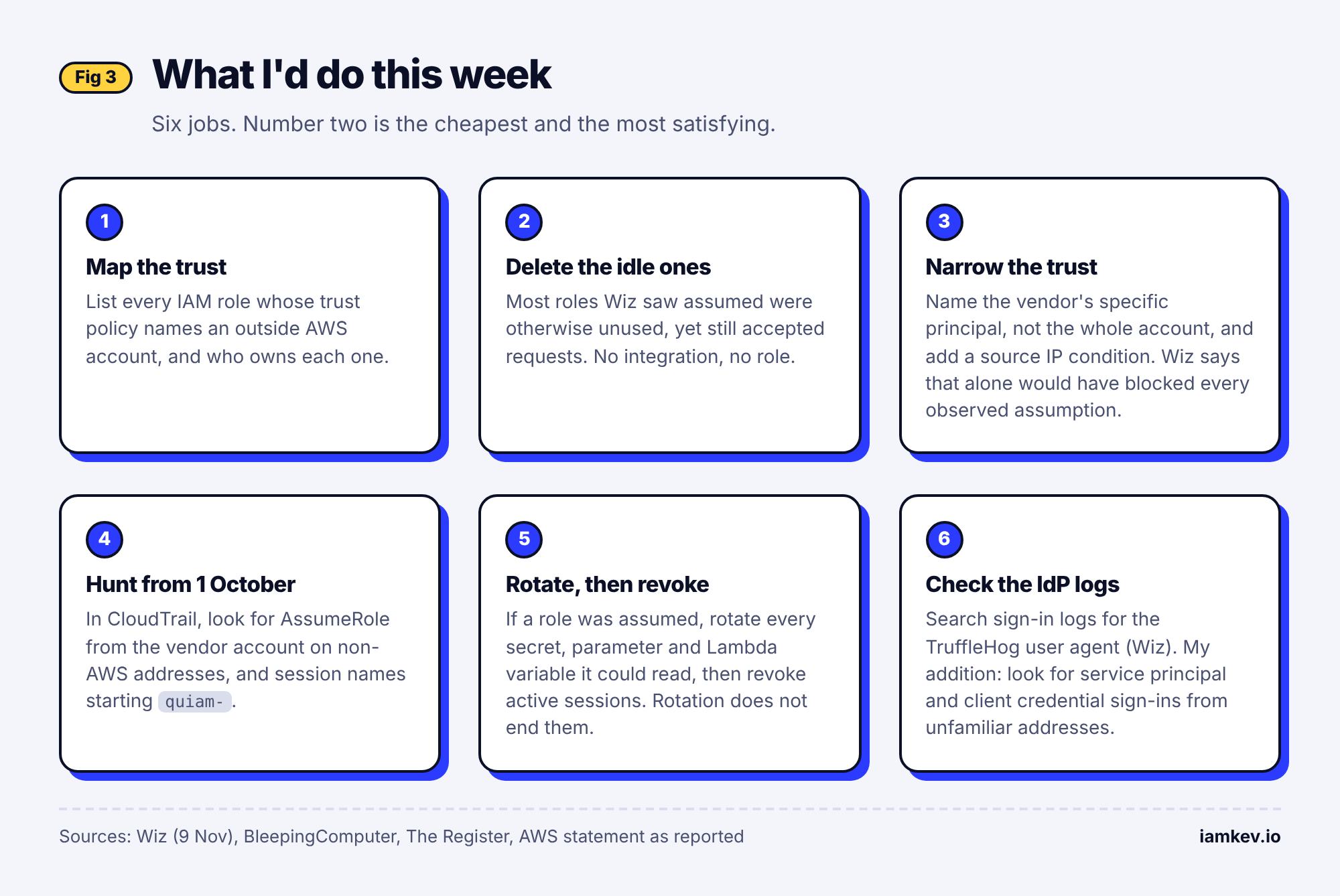
Map the trust. List every IAM role whose trust policy names an outside AWS account, and write down who owns each one.
- Delete the idle ones. If you are no longer using an integration, remove the role or take the vendor out of its trust policy. This is the cheapest job on the list.
- Narrow what remains. Trust the vendor's specific principal rather than the whole account, add
aws:SourceIporaws:SourceVpceconditions, and use a unique External ID per role where the vendor supports it. - Hunt from 1 October. In CloudTrail, in every account with an integration role, look for AssumeRole calls from the vendor account on non-AWS addresses, and for session names starting
quiam-. Wiz lists the account ID, IAM users and addresses in its report. That account also makes legitimate calls, so filter on the source address. - Rotate, then revoke. If a role was assumed, rotate every secret, parameter and Lambda environment variable it could read, Entra and Okta client secrets included, then revoke the role's active sessions. Wiz is clear that rotating a credential does not end sessions already issued.
- Check the identity provider logs. Wiz suggests searching sign-in logs for the TruffleHog user agent. My addition: look for service principal and client credential sign-ins from addresses you do not recognise.
The recovery question
Could you list, today, every secret that a vendor role in your accounts can read?
If a vendor's credentials were stolen tonight, could you rotate all of those secrets, revoke the live sessions, and show that nothing was added to your service principals or your Okta applications in the meantime? Rotation without revocation leaves the door open for as long as the session lasts. Detection without a list of what the role could reach leaves you guessing.
Most of us can answer the first question for the secrets we know about. The harder one is the roles we have forgotten we created.
Which vendor roles in your accounts have not been used in the last 90 days, and who would notice if they vanished? I would like to hear what you find. If you want more of this, subscribe and the next one will land in your inbox.
Sources
Qubole cross-account access
- Wiz, "Trusted by Default: Qubole Cross-Account Access Abused in the Wild", 9 November 2026 (updated 11 November): https://www.wiz.io/blog/qubole-cross-account-access-abused-in-the-wild
- BleepingComputer, Bill Toulas, 10 November 2026 (AWS statement added 11 November): https://www.bleepingcomputer.com/news/security/hackers-exploit-trusted-aws-access-to-breach-multiple-cloud-environments/
- The Register, 9 November 2026 (updated 10 November): https://www.theregister.com/security/2026/11/09/attackers-backdoor-trusted-aws-integrations-to-steal-secrets/5308553
- CSO Online, Shweta Sharma, 10 November 2026: https://www.csoonline.com/article/4246780/qubole-supply-chain-attack-exposed-aws-entra-id-and-okta-credentials.html
Related
- Last Week in Identity, Week 45: https://iamkev.io/last-week-in-identity-2026-w45/
Photo