

MS Ignite 2026 bingo, with receipts
 Kev Johnson
9 min read

Every November, the identity world plays the same game. Microsoft announces a lot of things in two hours, a lot of people write "transformational" in a lot of LinkedIn posts, and by February nobody can remember what was promised, what shipped, and what quietly became a preview with a licence attached.
So this year I'm writing my predictions down before the keynote, putting them on a board, and stamping them as the week goes on. Hits, partials and misses, all in public. If I get it badly wrong, at least it will be badly wrong with sources.
Ignite 2026 runs 17 to 20 November in San Francisco and online. The opening keynote, with Satya Nadella and Judson Althoff, is on Tuesday at 10:00 Pacific, which is 18:00 UK time. That's when the Book of News lands and the predictions start meeting reality.
Where we're starting from
Last year's Ignite was the one where agents got identities. Microsoft's own write-up called Entra Agent ID the "flagship introduction" for Entra, and the message was simple: agents should be first-class identities, with the same access management as people.
A year on, the plumbing has been filling in, mostly without a keynote:
- Agent lifecycle. Lifecycle policies for agent identities went into public preview, with a default inactivity policy at 60 days, according to the Entra team's November round-up.
- Who can make agents. From 4 November, Microsoft changed a default so that users without any Entra role can create agent identity blueprints, and therefore agents, unless an admin turns it off (MC1506733, rolling out until late November). Tony Redmond at Office 365 for IT Pros put it plainly: it's "absolutely not OK" to enable that by default. I'll let that sit there for a moment.
- Recovery. Entra Backup and Recovery went generally available on 30 June. It takes a daily backup of supported objects for P1 and P2 tenants and keeps seven days of history. Last week, documentation appeared for Hard Deletion Protection, a preview feature that blocks permanent deletion of a protected object for seven days after it's soft deleted.
- Authentication. Microsoft-provided SMS and voice MFA is retired on 1 February 2027 for most users, and on 1 July 2027 for Global Administrators and external users. Anyone whose only method is SMS or voice gets a blocking passkey prompt, and Microsoft's documentation says there is no opt out.
My read: last year was "agents get identities". This year's session catalogue reads like "now govern them, watch them, and get them back when it goes wrong". Whether the announcements match the catalogue is what the board is for.
The board
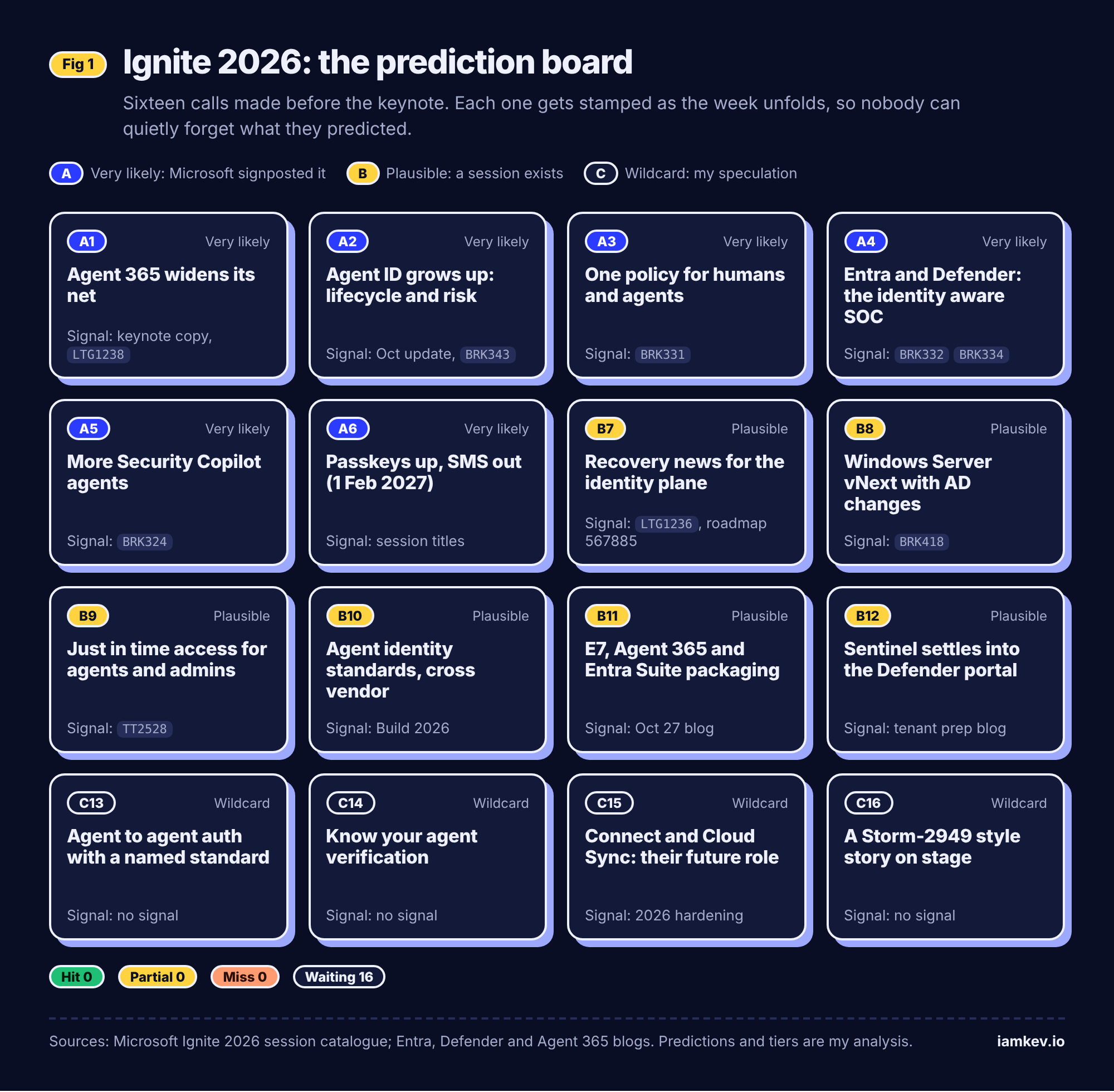
Sixteen calls in three tiers. The tiers are my judgement, and the "signal" on each card is what made me think it. As you can see, some of my predictions are... highly speculative. We'll see if I should be buying a lottery ticket this time next week!
Tier A: Microsoft has more or less told us. These come straight from session titles and descriptions. Agent 365 broadening what it governs, including MCP servers, plugins and skills (LTG1238). Entra Agent ID moving past "register and inventory" into lifecycle and risk (BRK343, the Entra news session). A single policy for humans and agents (BRK331, and yes, that's the actual session title). Entra and Defender pulling identity signals into the SOC (BRK332 and BRK334). More Security Copilot agents and an "agentic SOC" (BRK324, titled "The Alert Is Dead", which is a brave thing to say to a room full of people who have alerts). And the passkey drumbeat, with 1 February 2027 repeated until we all hear it in our sleep.
If Tier A doesn't land, something odd has happened.
Tier B: there's a session, but the detail is open. This is where the interesting news usually hides, and as someone who regularly builds this kind of session, you often need to submit a name and an abstract months before the event. Often, you don't know quite where the product will be come the big announcement, so there's a bit of an art to making a session sound sexy enough to get bums on seats, while also being vague enough that nobody can leave the session wondering what the hell just happened.
Recovery for the identity plane is my favourite (check my LinkedIn and you shouldn't be surprised), because there's a lightning talk on Thursday called "Oops! Someone Deleted a Critical Identity. Can You Get It Back?" (LTG1236), and a public roadmap item (567885) for 30-day Entra backup through Microsoft 365 Backup, listed as in development with a December target. Windows Server's next version gets a breakout that names Active Directory (BRK418). Then come just-in-time access for agents and admins, cross-vendor agent identity standards, some E7 and Agent 365 packaging, and Sentinel settling into the Defender portal.
Tier C: wildcards. No direct signal, so I've labelled them as my speculation: agent-to-agent auth with a named standard, a "know your agent" verification story, a clearer future for Entra Connect and Cloud Sync, and a Microsoft incident story told on stage as evidence that identity is the control plane.
What I'm not predicting: a date for retiring Active Directory, or any "AD is dead" moment. Nothing supports it, and the people who run AD have heard that one before.
I betcha there will be a few blogs that state otherwise, but AD has been the great survivor so far, and I can't see it going away any time soon. At this point, Entra ID is old enough to buy a beer in my country, and it never ceases to amuse me the number of folks who refer to it as "legacy" purely because it's been around 8 years more than Entra.
The gap I'll be watching
Prediction boards are fun. The figure below is the part I care about.
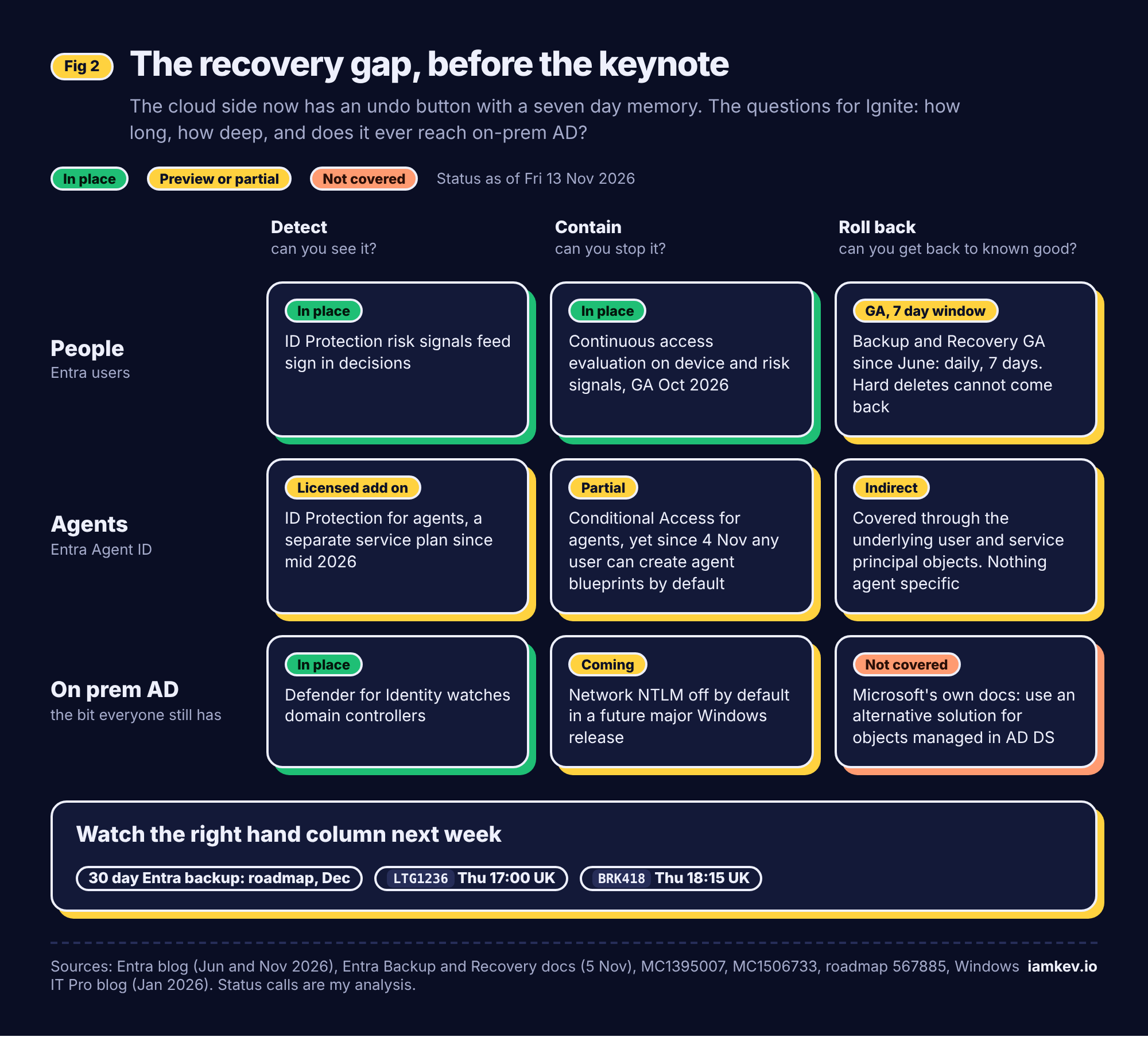
For people in Entra, the picture is better than it was a year ago. Detection and containment are mature, and there is now a built-in undo button. It has a seven-day memory, it can't bring back hard-deleted objects, and it only covers supported objects and properties. Hard Deletion Protection helps with the "someone emptied the recycle bin" scenario, but read the small print first: once you switch it on for an object, you can't switch it off. Treat it like a tattoo, not a sticker.
For agents, Microsoft's documentation says Backup and Recovery and Hard Deletion Protection cover Agent ID through the underlying user and service principal objects. That's useful, and I'd marked it as a gap before I checked, so credit where it's due. What I haven't seen is anything agent-shaped. An agent's blast radius is usually its permissions, its tools and who it can act for. "Restore the service principal" and "undo what the agent was allowed to do last Tuesday" are not the same sentence.
For on-prem AD, Microsoft's own Backup and Recovery documentation is refreshingly direct: for objects managed in AD DS, use an alternative solution (again, check my LinkedIn, but this is a personal blog, and I'm not here to sell you anything). In hybrid tenants, the source of truth for many of your users is still AD. My read: that means a lot of real incidents start in the place the native cloud tooling explicitly doesn't cover. That isn't a criticism of the Entra team, who have shipped a lot this year. It's a reminder that the directory most attackers go after first is still the one in your server room.
So my test for the week is one question, and it's the same one I ask about every story: could you detect it, contain it, and roll the identity plane back to known-good, including the agents? Next week I'll be watching whether anything announced moves the right-hand column.
Five things to check before Tuesday
None of these depend on what gets announced.
- Who can create agents in your tenant. In the Entra admin centre, go to Users, then User settings, then Default user role permissions, and look for the agent identity blueprint setting. Microsoft's post calls it "Users can create agent blueprints"; some tenants show it as "Users can register agent identity blueprints". Decide on purpose rather than by default. It's separate from "Users can register applications", so check both.
- Your SMS and voice stragglers. Find the users whose only MFA method is SMS or voice, and include your Global Administrators and external users in the July 2027 cohort. A blocking passkey prompt on 1 February is a support-desk event, not a security win, if nobody's warned.
- What Backup and Recovery covers for you. It's already in your tenant if you have P1 or P2. Run a difference report, read the supported objects list, and note the seven-day window and the hard-delete limitation in your incident runbook. Then decide, carefully, which few objects deserve Hard Deletion Protection.
- Your agent inventory. Look at the agent identities you already have and who sponsors them, and check the 60-day inactivity default against reality.
- Your NTLM dependencies. Microsoft's plan ends with network NTLM disabled by default in a future major Windows release, and the auditing tools are available now. Better to find the app that still needs it in November than during an upgrade.
How I'll keep score
The board gets stamped each evening of Ignite. The sessions I'm watching most closely, in UK time:
- Tue 17 Nov, 18:00: opening keynote and the Book of News.
- Wed 18 Nov, 18:15: BRK343, the Entra news session, with Yina Arenas and John Savill.
- Thu 19 Nov, 17:00: LTG1236, the "someone deleted a critical identity" talk.
- Thu 19 Nov, 18:15: BRK418, Windows Server, including Active Directory.
- BRK332, "Identity knows what your SOC doesn't": Microsoft's own pages disagree on whether it's Thursday or Friday, which is either an oversight or a very committed bit about identity data quality. Check the live catalogue.
Tier A will probably land. Tier C probably won't, and that's fine; that's why it's Tier C. The column I'll actually be judging the week on is the right-hand one in Fig 2. If we come out of Ignite with longer recovery windows and something that treats an agent's permissions as recoverable state, that will be a good week for identity resilience. If it's mostly new agents to watch the other agents, we'll have more to detect and the same amount to get back.
Either way, I'll stamp the board.
Sources
Microsoft
- Microsoft Security blog, "Secure what's next: your guide to Microsoft Security at Microsoft Ignite 2026" (30 Sep 2026): https://microsoft.com/en-us/security/blog/2026/09/30/secure-whats-next-your-guide-to-microsoft-security-at-microsoft-ignite-2026
- Microsoft Entra blog, "Catch Microsoft Entra at Ignite 2026": https://techcommunity.microsoft.com/blog/microsoft-entra-blog/catch-microsoft-entra-at-ignite-2026/4513159
- Microsoft Defender and Sentinel, "Catch Microsoft Defender and Sentinel at Ignite 2026" (Nov 2026): https://techcommunity.microsoft.com/blog/microsoftthreatprotectionblog/catch-microsoft-defender-and-sentinel-at-ignite-2026/4572639
- Agent 365 blog, "Microsoft Ignite 2026: Your guide to Agent 365" (Nov 2026): https://techcommunity.microsoft.com/blog/agent-365-blog/microsoft-ignite-2026-your-guide-to-agent-365/4571750
- Windows Server blog, "Windows Server at Microsoft Ignite 2026" (Nov 2026): https://techcommunity.microsoft.com/blog/windowsservernewsandbestpractices/windows-server-at-microsoft-ignite-2026-sessions-our-booth-and-how-to-join-the-p/4569969
- Microsoft Learn, "What's new in Microsoft Entra: Ignite 2025": https://learn.microsoft.com/en-us/entra/fundamentals/whats-new-ignite-2025
- Microsoft Entra blog, "What's new in Microsoft Entra: November 2026" (6 Nov 2026): https://techcommunity.microsoft.com/blog/microsoft-entra-blog/what%e2%80%99s-new-in-microsoft-entra-november-2026/4556457
- Microsoft Entra blog, "Microsoft Entra Backup and Recovery is now generally available" (30 Jun 2026): https://techcommunity.microsoft.com/blog/microsoft-entra-blog/microsoft-entra-backup-and-recovery-is-now-generally-available/4521997
- Microsoft Learn, "Microsoft Entra Backup and Recovery overview" (updated 5 Nov 2026): https://learn.microsoft.com/en-us/entra/backup/overview
- Microsoft Learn, "Configure Hard Deletion Protection in Microsoft Entra (preview)" (updated 5 Nov 2026): https://learn.microsoft.com/en-us/entra/backup/configure-hard-deletion-protection
- Microsoft Learn, SMS and voice authentication retirement: https://learn.microsoft.com/en-au/entra/identity/authentication/concept-sms-voice-retirement
- Message Center MC1506733, "Review who can create agents in Microsoft Entra" (13 Oct 2026), via Merill Fernando's mirror: https://mc.merill.net/message/MC1506733
- Microsoft 365 Roadmap 567885, "Entra ID Backup & Recovery" (30-day backup via Microsoft 365 Backup), via Merill Fernando's mirror: https://mc.merill.net/message/RM567885
Independent
- Tony Redmond, Office 365 for IT Pros, on the agent blueprint default (15 Oct 2026): https://office365itpros.com/2026/10/15/agent-blueprint-option/amp/
- Help Net Security, "Microsoft Entra adds a seven-day safeguard against irreversible identity deletion" (12 Nov 2026): https://www.helpnetsecurity.com/2026/11/12/microsoft-entra-hard-deletion-protection/
- Help Net Security, on Microsoft's plan to switch off NTLM (2 Feb 2026): https://www.helpnetsecurity.com/2026/02/02/microsoft-windows-ntlm-disabling/
- IT Pro Tips, on where to find the blueprint setting (14 Oct 2026): https://itpro-tips.com/entra-from-november-4-your-users-can-create-agent-identity-blueprints/
Photo by <a href="https://unsplash.com/@philipsfuture">Philip Oroni</a> on <a href="https://unsplash.com/photos/a-close-up-of-a-bunch-of-balls-on-a-table-deR8eZHXyOc">Unsplash</a>