

Blind Spots at Ring Zero: Patching and Monitoring ESXi After CVE-2026-41709
A CVSS 2.7 logging flaw in VMware ESX is now on CISA's KEV list after being used as a zero-day. Here's why it matters, how to patch, and how to get visibility that doesn't depend on the host telling the truth.
 Kev Johnson
5 min read
For those of you who don't know me, I spent a fair chunk of my career inside vSphere: building it, selling it, fixing it at 2am. So when CISA added a CVSS 2.7 ESX vulnerability to its Known Exploited Vulnerabilities (KEV, no relation, I promise) catalogue last week, it caught my eye. On paper it's a "Low". In practice it's the kind of bug a careful attacker loves, because it doesn't help them get in. It helps them not get noticed once they're there.
Here's what's going on, why the score is misleading, and what I'd be doing this week if I still ran an ESXi estate.
What actually happened
- 29 July 2026: Broadcom published VMSA-2026-0006, fixing CVE-2026-41709, an insufficient logging weakness (CWE-778) in VMware ESX. In Broadcom's words, a malicious actor with administrative privileges could perform certain operations without them being logged. It was reported by CrowdStrike. The advisory is now at revision 0006.2, last updated 19 August 2026.
- 28 October 2026: CrowdStrike's 2026 Legal Threat Landscape Report said a China-nexus group it tracks as WARP PANDA had used this "ESXi command logging bypass" as a zero-day in several intrusions at US organisations, including law firms, as late as early 2026. The group also deployed malware inside victims' vCenter environments.
- 28 October 2026: CISA added the CVE to KEV. US federal agencies have until 11 November 2026 to remediate.
A few things haven't been disclosed. Broadcom hasn't said exactly which operations go unlogged, there are no public indicators of compromise, and there's no victim count. Keep that in mind when you read anything more dramatic than the above.
Why a 2.7 belongs near the top of your list
CVSS measures the flaw in isolation. This one needs admin rights, doesn't touch confidentiality or availability directly, and has a small integrity impact. So it scores low, and that's fair as a description of the bug.
But nobody exploits a logging bypass on its own. It sits in the middle of a chain:
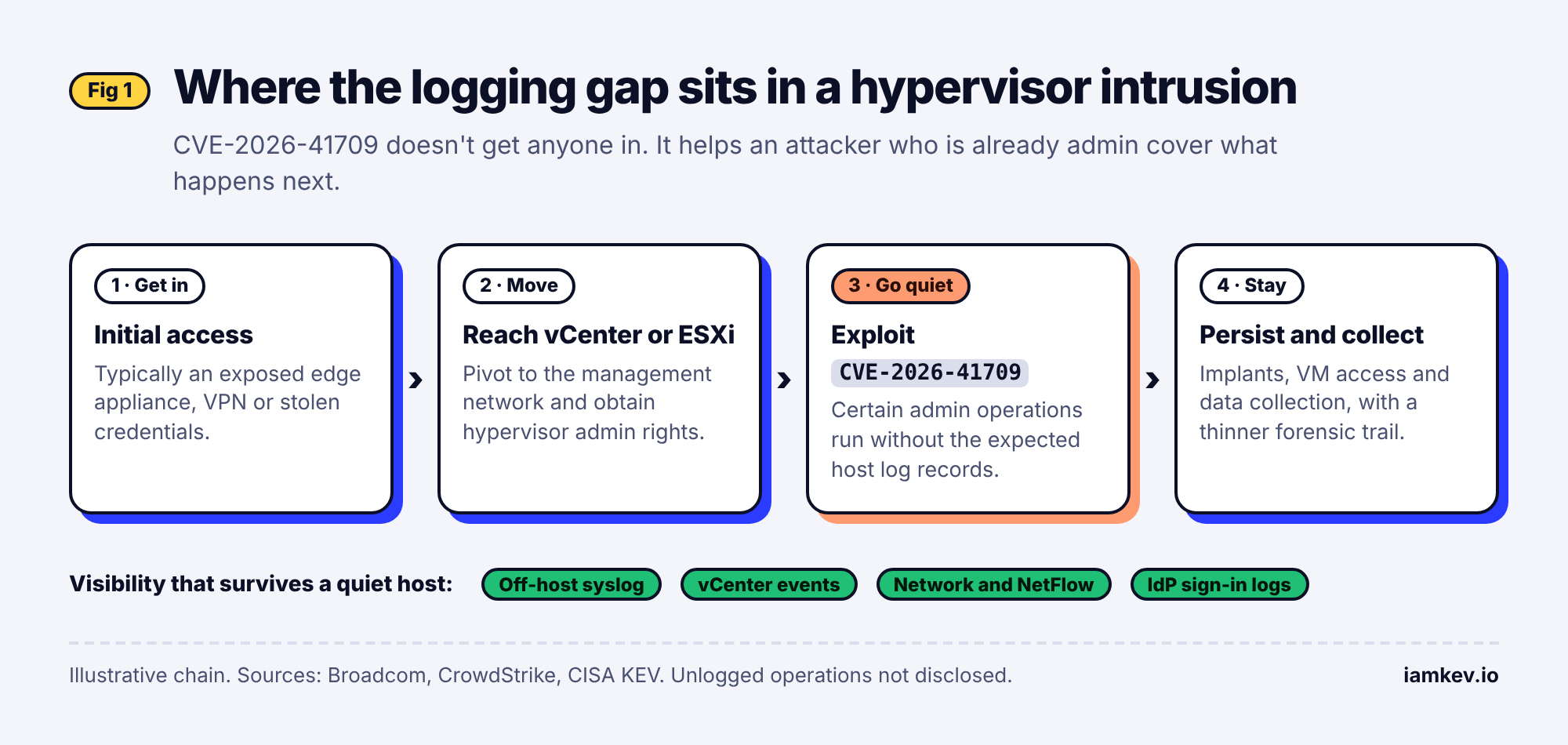
- Get in. Usually an exposed edge device, a VPN appliance or stolen credentials.
- Move. Pivot to the management network and get admin on vCenter or ESXi.
- Go quiet. Use CVE-2026-41709 so certain admin actions don't leave the host records you'd expect.
- Stay. Implants, access to VMs and data, with a much thinner forensic trail.
By step three the attacker already has the keys to every VM on that host. What this flaw changes is how much you can reconstruct afterwards. If your incident response plan relies on host logs to work out what was touched, encrypted or copied, it just got weaker.
That's the lesson I keep coming back to: prioritise by exploitation and position in the attack chain, not by score alone. KEV exists for exactly this reason. A flaw in the hypervisor, being used by a capable actor, matters more than its number suggests.
What to do this week
1. Patch
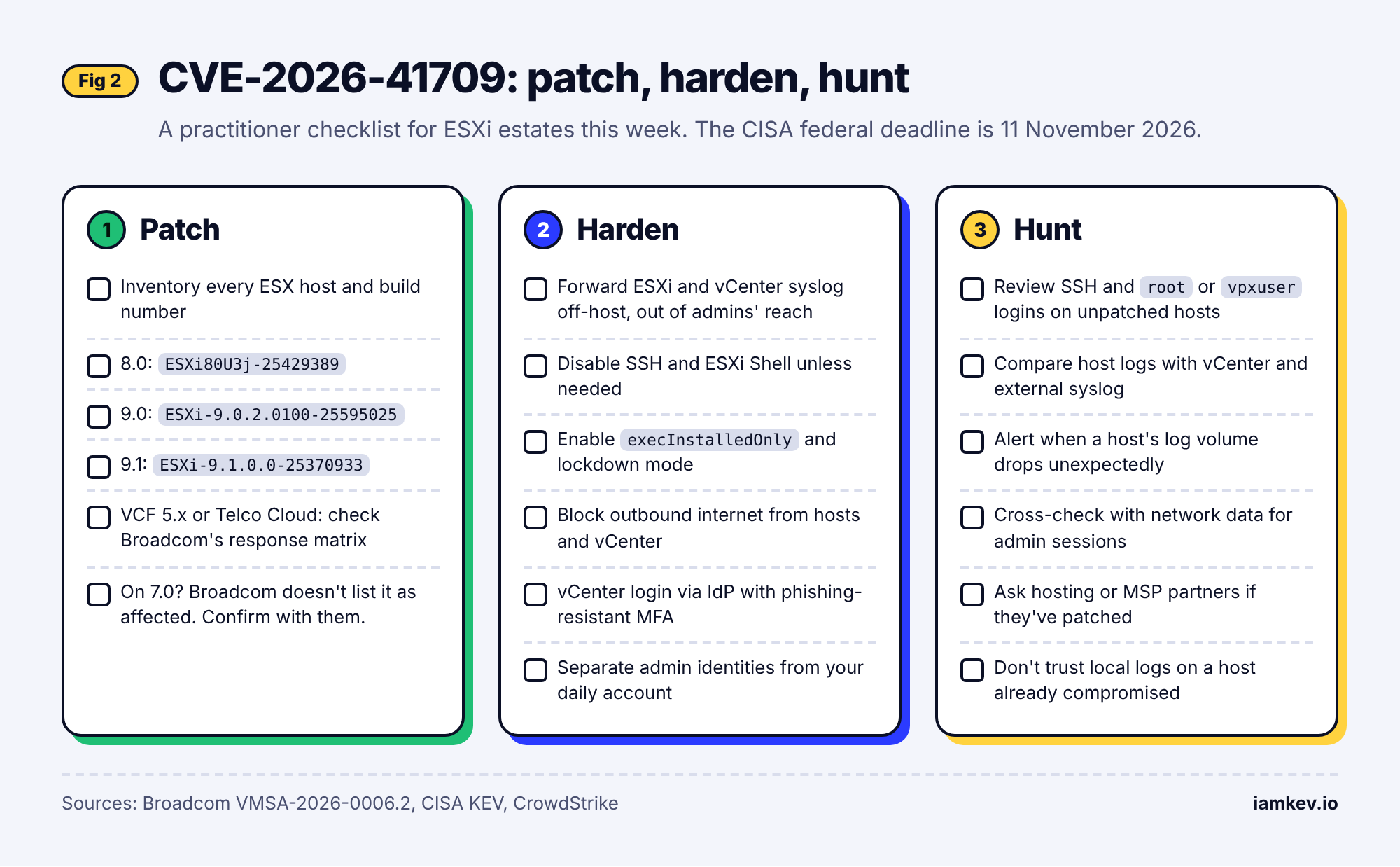
Get an accurate inventory of every ESX host and its build first. Then move each one to the fixed build for its release:
| Release | Fixed build |
|---|---|
| ESXi 8.0 | ESXi80U3j-25429389 |
| ESXi 9.0 | ESXi-9.0.2.0100-25595025 |
| ESXi 9.1 | ESXi-9.1.0.0-25370933 |
If you're on VMware Cloud Foundation 5.x or Telco Cloud Platform, follow the response matrix in the advisory rather than assuming a general update covers it. Broadcom lists no workaround. Broadcom doesn't list ESX 7.0 as affected by this CVE (the 19 August update added 7.0 guidance for the Critical issues only), so if you're still on 7.0, confirm your position with them directly.
A quick way to check builds across a cluster with PowerCLI. It compares each host's build number with the fixed build for its release:
powershell
$fixed = @{ '8.0' = 25429389; '9.0' = 25595025; '9.1' = 25370933 }

Get-VMHost | ForEach-Object {
  $release = ($_.Version -split '\.')[0..1] -join '.'
  $target  = $fixed[$release]
  $status  = if (-not $target) { 'Not in the fixed list: check the advisory' }
             elseif ([int]$_.Build -ge $target) { 'At or above the fixed build' }
             else { 'Needs patching' }
  [pscustomobject]@{ Name = $_.Name; Version = $_.Version; Build = $_.Build; Status = $status }
} | Sort-Object Status, Name | Format-Table -AutoSize
Treat the output as a first pass, not proof. Confirm anything odd against the advisory.
2. Harden: assume the host might lie
Patching closes this hole. It doesn't make you resilient to the next one. The bigger fix is to make sure your visibility doesn't depend on the host being honest.
- Ship logs off-host. Forward ESXi and vCenter syslog to a system that ESX admins can't change or delete, and keep it long enough to matter.
- Shrink the admin surface. Disable SSH and the ESXi Shell unless you're actively using them. Enable lockdown mode and
execInstalledOnlyso only signed, installed binaries can run. - Cut outbound access. Hosts and vCenter rarely need to reach the internet. Block it by default.
- Treat vCenter as an identity problem. Put vCenter sign-in behind your identity provider with phishing-resistant MFA, and use dedicated admin accounts, never your everyday one.
3. Hunt on hosts that ran unpatched builds
- Review SSH sessions and logins as
rootandvpxuser, especially at odd hours or from unusual sources. - Compare what the host says with what vCenter, your external syslog and your network data say. Gaps and mismatches are the signal.
- Alert when a host's log volume drops unexpectedly. Silence is an event.
- If you use a hosting provider or MSP for any of your vSphere estate, ask them whether they've patched, and whether hypervisor logs leave the host.
One important caveat: patching a host that has already been compromised doesn't make its earlier local logs trustworthy. If something looks off, investigate using the external sources.
The bigger picture: the hypervisor is a tier-zero asset
We treat domain controllers and identity providers as tier zero, and rightly so. The hypervisor deserves the same treatment. Whoever controls it controls every workload on it, including, quite often, your domain controllers and your backup infrastructure.
Hypervisors are also often the least monitored layer in the stack. EDR agents don't run on ESXi, and plenty of estates still keep logs only on the host. That's the gap attackers aim for, and it's why I'd spend as much time on step two above as on the patch itself.
It's also a recovery question. If you can't trust what the hypervisor tells you, you need to be confident that your recovery copies, and the identities that manage them, live somewhere an attacker with hypervisor admin can't reach.
A homelab aside
My own lab runs on Harvester and Rancher rather than vSphere these days, and the same principles apply even though this CVE doesn't. Treat the platform layer as tier zero. Ship node and audit logs off the cluster. Keep admin access behind SSO and separate from everyday accounts. Don't leave SSH open on nodes "just in case". A homelab is a good place to build those habits before you need them at work.
Wrapping up
CVE-2026-41709 is a good reminder that a severity score describes a bug, not your risk. Patch before the 11 November KEV deadline whether or not you're a federal agency, then use it as a prompt to check that your hypervisor telemetry would survive an attacker with admin rights.
Over to you: do you forward ESXi logs off-host today, and would you notice if a host went quiet?
Sources
- Broadcom, VMSA-2026-0006.2 (first published 29 Jul 2026, last updated 19 Aug 2026)
- CISA, Known Exploited Vulnerabilities catalog
- CrowdStrike, 2026 Legal Threat Landscape Report (28 Oct 2026)
- Rescana, VMware ESX CVE-2026-41709 analysis (29 Oct 2026)
- Cyber Security News, VMware ESX logging vulnerability exploited (29 Oct 2026)