

Backups first, backups last: what the 3AM school attack says about recovery
The AI angle got the headlines. The attack itself was about backup credentials, domain admins and domain trusts, and that's the part worth learning from.
 Kev Johnson
5 min read

Last week, Bitdefender published a long write-up of a ransomware intrusion at a UK school estate, and most of the coverage went straight for the AI angle. Fair enough: "hybrid AI ransomware" is a better headline than "attacker steals backup credentials and does admin things".
Take the sensationalisation out of it, though, and the boring version is the one practitioners should read. Take the AI out of this story entirely and you still have an attack that most estates would struggle to stop, because every step that mattered was about identity and backup, not clever malware.
Everything below comes from Bitdefender's report, published on 3 November 2026. Where something is either unknown or only assessed, I'll say so.
What happened, briefly
Bitdefender attributes the intrusion to an affiliate of the 3AM (ThreeAM) ransomware-as-a-service operation, and says that attribution is confirmed. The activity ran through September 2026. The victim was a school estate with 47 systems on its machine list, including eight domain controllers, and several Active Directory domains that started out unconnected.
How the attacker first got in is unknown. Bitdefender is upfront about that.
From there, the September timeline goes roughly like this:
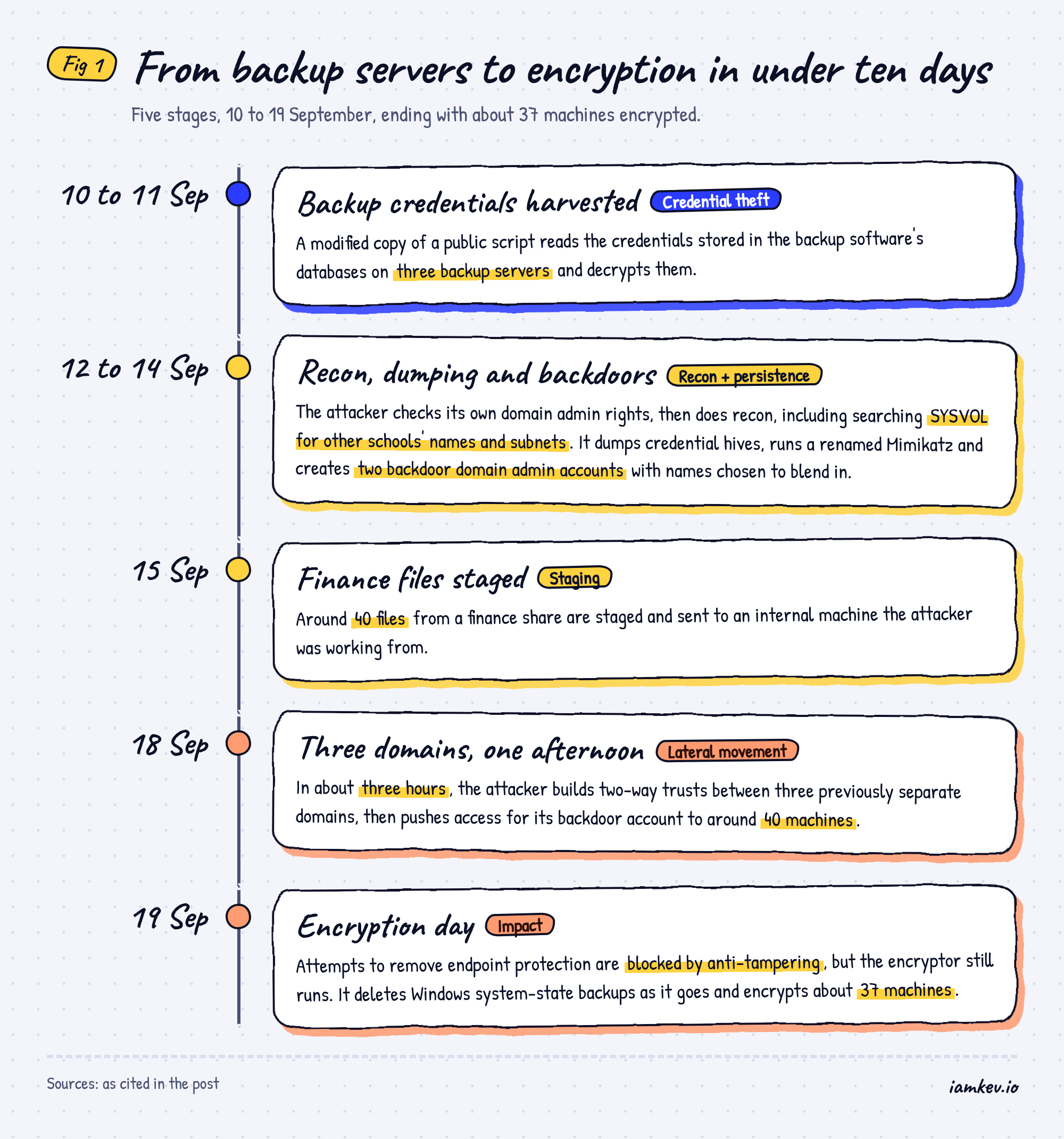
Every attacker action that Bitdefender saw came from an unmanaged machine inside the network: one running no Bitdefender agent, so it sat outside their visibility.
Backups first
The first thing the attacker went for wasn't the domain controllers. It was the backup servers. Why? Because with a tiny bit of research into the tools in use, they knew that doing this would give up highly privileged credentials with little effort.
That makes complete sense from the attacker's side. Backup software has to touch everything, so it tends to hold credentials that can touch everything. Read those out of the backup database and you have a skeleton key for the estate, often with rights well beyond what any single admin would carry day to day.
Bitdefender's phrase for the fix is worth repeating: treat backup as a target, and review your backup strategy for malicious intent. Most backup designs assume the threat is a failed disk or a deleted folder. They don't assume someone is sitting on the network reading the backup server's credential store.
Identity in the middle
With those credentials, the attacker did the things that turn a foothold into ownership:
- Created domain admins. Two backdoor accounts, created by two different routes, so removing one wouldn't end the access.
- Joined the domains together. The estate's domains were separate. The attacker made them not separate, using built-in Windows tools to create two-way trusts. According to Bitdefender, the backdoor account had already been created in several domains before the trusts were built, which is how it had the rights to build them.
Both of those are rare events on a healthy network. Nobody creates a new domain trust on a Tuesday afternoon for fun. Bitdefender's own recommendation is to put trusts and domain admin accounts behind change control and alert on every one that appears without it. That's cheap to do, and it would have flagged the middle of this attack.
The other lesson is about separation that only exists on a diagram. Separate domains are only separate if their admin credentials are too. If one system (say, a backup server) holds privileged credentials for several domains, those domains share a weak point, whatever the architecture slide says.
Backups last
When it came to encryption, the encryptor deleted system-state backups on the way through. It's standard ransomware behaviour, which is exactly why it matters: if your recovery plan relies on copies that a domain account can delete, the attacker who owns the domain can delete them.
Bitdefender's advice is to scope backup accounts per domain, isolate the backup servers, and keep immutable recovery copies that no domain account can delete.
I'd add one recovery point to that. In an attack like this, the directory is part of the crime scene. Backdoor admins, new trusts and pushed permissions all live in Active Directory. Restoring servers and file shares is only half a recovery if the identity layer you restore them into still has the attacker's accounts in it. Knowing what a clean directory looks like, and how you'd get back to one, is part of the backup plan, not an afterthought.
The unmanaged machine
The detail I keep coming back to: the machine the attacker worked from was unmanaged, with no Bitdefender agent on it. That's why Bitdefender can't say who or what was typing the commands, and it's the machine most likely to hold any automation. It was also where the stolen finance files were sent.
Their recommendation is short: put an endpoint agent on every machine. The machines you can't see are the ones that matter most in a story like this.
So, about that AI
Bitdefender is careful here, and the care deserves more airtime than the headline got.
Their assessment, in plain terms:
- A language model wrote the commands: strongly supported. There are tells like a backup software API call using a port and login method that don't match the vendor's documentation, Unix habits turning up in Windows commands, and numbered revisions of the same script.
- An automated loop was choosing each next step: the behaviour looks like one, with retries arriving at a steady pace of 40 seconds or more whatever the size of the change. But a person copying and pasting between a shell and a chat window could produce the same rhythm.
- No human involved: unsupported. Nothing in the telemetry speaks to it.
They also say this is one case, an anecdote and not a trend; that the attack wasn't fast; and that nothing in it was novel. Built-in tools, a few public ones and a commodity encryptor.
Which is the real point. If the AI part had been absent, every defensive lesson above would be identical. A model didn't make backup credentials readable, domain trusts unmonitored or a machine unmanaged. It just did the fiddly typing.
What I'd check this week
Pulled from Bitdefender's recommendations, plus the recovery point above:
- Backup server credentials. What does each backup server hold, for which domains, and what could someone do with them? Scope backup accounts per domain where you can. Also ask why it's possible for an attacker to gain access to those credentials - they're likely to be highly privileged, and so should be guarded as such.
- Alerts on trust creation and new domain admins. Both should be rare enough to alert on every time.
- Alerts on reading backup databases and saving registry hives. Bitdefender calls out access to backup software credential stores and
reg saveof the SECURITY, SYSTEM or SAM hives by anything other than a known job. Both sat at the front of this intrusion. - Immutable recovery copies. Can any domain account delete them? If yes, they aren't the last line of defence.
- Unmanaged machines. Find them. Then either manage them or get them off the network.
- A plan for a clean directory. If AD were compromised tomorrow, how would you know which accounts, trusts and permissions to trust?
None of that is new or glamorous, which is kinda my point. The attacker in this case didn't need anything new either.
Sources
- Bitdefender, "3AM Hits European Schools: A Hybrid AI Ransomware Attack, Part Human, Part Agentic Loop" (3 November 2026): https://www.bitdefender.com/en-gb/blog/businessinsights/3am-ransomware-hybrid-ai-attack
- BleepingComputer, "UK school estate hit by 3AM ransomware in suspected AI-assisted attack" (3 November 2026): https://bleepingcomputer.com/news/security/uk-school-estate-hit-by-3am-ransomware-in-suspected-ai-assisted-attack
- Hackread, "3AM Ransomware Hits 37 UK School Systems in Suspected AI-Assisted Attack": https://hackread.com/3am-ransomware-uk-school-systems-ai-attack/